Academic grounding
Families get a program shaped by university-level creative computing leadership, not a generic prompt-tool workshop.
A parent-friendly summer AI experience for high school students
This summer program is designed for families who want more than passive screen time and more than hype. Designed by Ira Greenberg — Professor and Chair of the Center of Creative Computation at SMU and CEO of gogentic.ai — the program helps students learn how AI works, where it helps, where it can mislead, and how to use it creatively, responsibly, and confidently in school and life.
Program leadership
Ira Greenberg is Professor and Chair of the Center of Creative Computation at SMU and CEO of gogentic.ai. His work sits at the intersection of creative practice, computation, AI literacy, and real-world learning — which is why this program treats AI as both a technical shift and a human, creative, ethical one.
Families get a program shaped by university-level creative computing leadership, not a generic prompt-tool workshop.
Students learn habits they can use beyond summer: asking better questions, testing outputs, revising work, and explaining choices.
Why this matters now
Parents can feel the shift: AI is changing homework, creativity, communication, and future career paths. The real question is not whether your child will encounter AI. It is whether they will learn to approach it thoughtfully, critically, and with confidence.
Students learn what AI is, what it is not, and how to question outputs instead of taking them at face value.
They do not just prompt tools. They make projects, solve problems, and turn ideas into visible work.
We treat ethics, bias, authorship, and responsibility as part of literacy, not as an afterthought.
The experience can help students imagine future majors, internships, portfolios, and career directions.
The parent case in one sentence
This is a summer program for families who want their kids to be capable, thoughtful, and future-ready — not passive users of the next wave of technology.
Two ways to begin
Some students want a fast, inspiring introduction. Others are ready for a deeper creative and applied experience. This companion site presents both clearly for families.
Ideal for students who are curious about AI, creative technology, or future career pathways but are not yet ready to commit to a longer experience.
Ideal for students who want more time to build, experiment, collaborate, and grow real fluency with AI tools, creative workflows, and project development.

What the room feels like
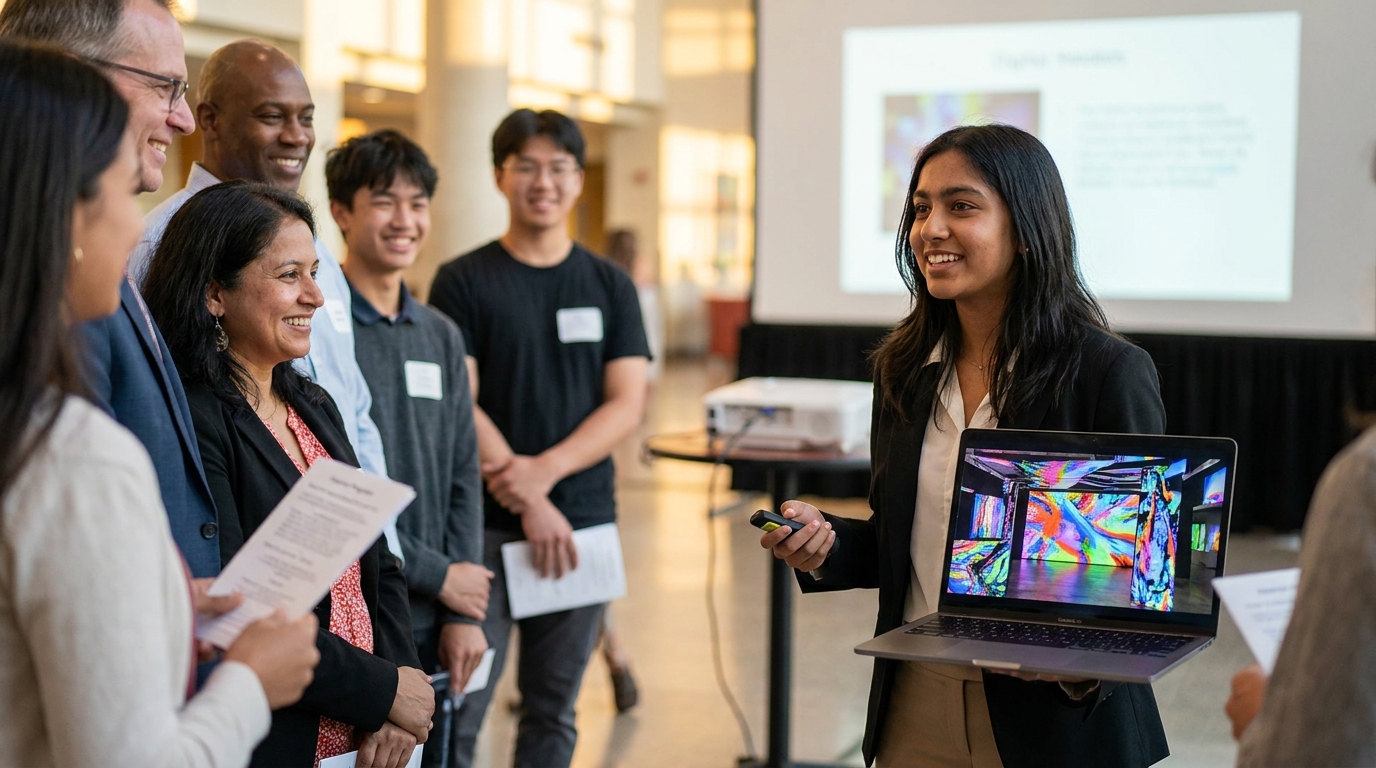
The best version of this program feels less like a lecture and more like a guided studio: students ask questions, compare ideas, help each other, and discover that AI literacy can be social, creative, and deeply human.
What students actually do
Students explore AI through making, discussion, critique, and presentation. They ask questions, test ideas, compare results, and build projects with real human guidance.
Students learn how AI systems work, where they succeed, and where they fail.
They examine what makes AI helpful, risky, incomplete, or misleading.
They use AI as a creative partner for visual, written, and design-oriented work.
They connect AI to community issues, future careers, and meaningful problem-solving.
Students leave with concrete work, stronger language for explaining it, and a new sense of possibility.
What students gain
The point is not to turn every student into an engineer in a week. The point is to help them become more capable, more thoughtful, and more confident in a world where AI will increasingly shape school and work.
Students stop feeling behind and start understanding how to approach unfamiliar tools.
They learn to question, evaluate, revise, and not confuse fast answers with good answers.
They use AI to extend their own ideas instead of replacing their own thinking.
Students talk about what they made, why they made it, and what they learned.
The experience can support later coursework, college applications, portfolio development, and career exploration.
Why families tend to respond to this
Maybe your child is creative, bright, and interested in the future, but unsure where to begin. This gives them a structured starting point.
Maybe they are intimidated by tech or assume AI is only for coders. This shows them they belong in the conversation too.
Maybe they are already experimenting on their own. This helps turn scattered curiosity into stronger habits, projects, and direction.
Parent FAQ
No. The program is designed so students can begin without a coding background. Curiosity matters more than prior experience.
No. It is valuable for students interested in art, design, writing, entrepreneurship, media, community problem-solving, and many other paths.
At home, students usually get speed and novelty. Here, they get structure, context, critique, ethics, collaboration, and guided project work.
Yes. Students are taught to examine limits, bias, authorship, and responsibility as part of the experience.
That is common. The learning environment is designed to be supportive, welcoming, and confidence-building rather than competitive.
They leave with projects, vocabulary for talking about AI intelligently, and more confidence about how to participate in a rapidly changing future.
Next step
We can help you think through which format is the best fit: the 1-week seminar, the multi-week camp, or the broader AI literacy pathway behind them. The program is designed by Ira Greenberg, Professor and Chair, Center of Creative Computation at SMU, and CEO of gogentic.ai.